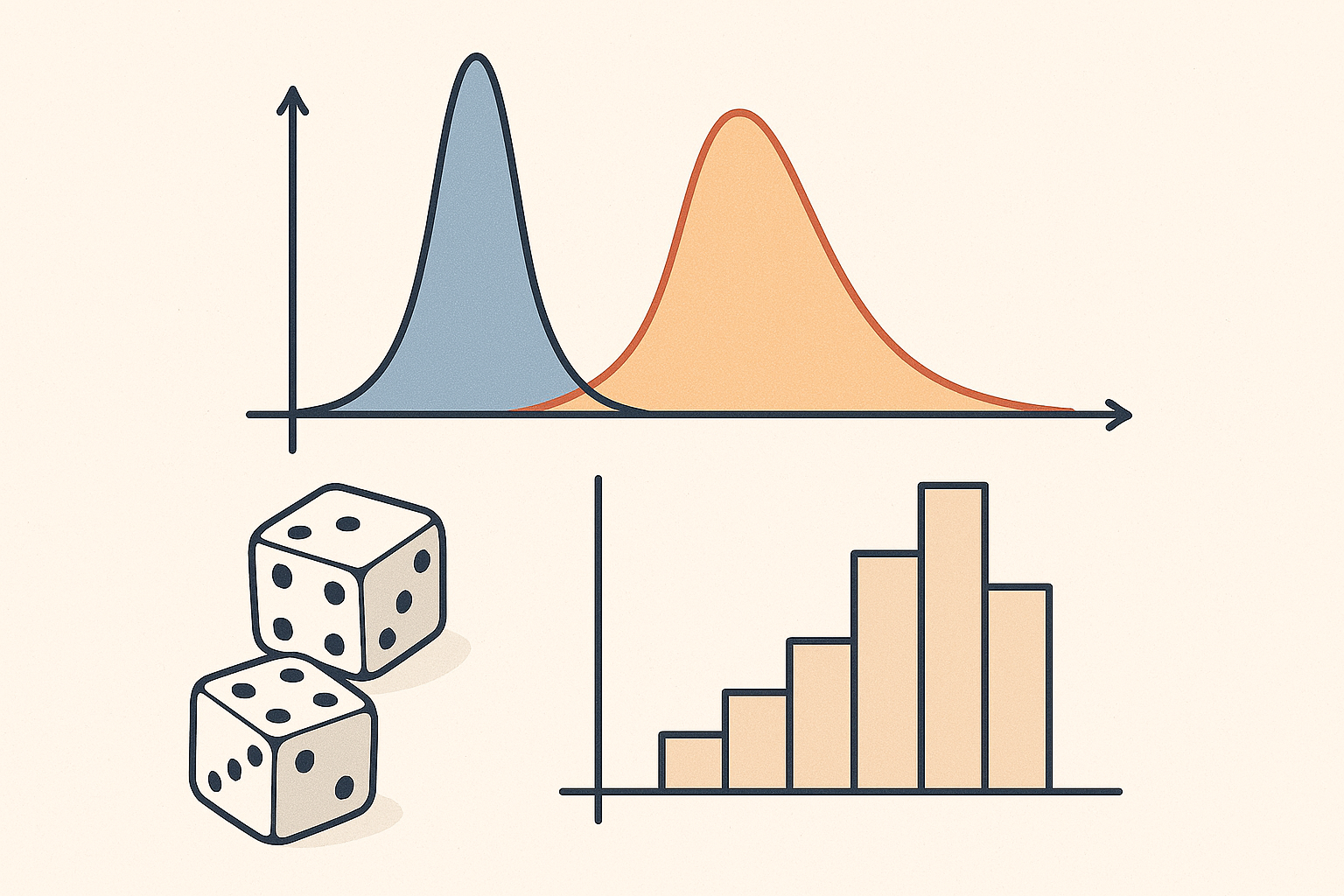
Module 2 Probability and Probability Distribution
This module introduces students to the foundational concepts of probability, focusing on how randomness is quantified and how events are analyzed mathematically. Learners begin by exploring random experiments, sample spaces, and events, using familiar examples such as dice rolls and coin tosses. The relationships among events are described using set operations—union, intersection, and complement—and visualized through diagrams.
Students then learn to calculate probabilities, particularly when outcomes are equally likely, applying rules such as \(P(A)= m/n\) where \(m\) is the number of favorable outcomes and \(n\) is the total number of possible outcomes. The module introduces and explains the axioms of probability, including the addition rule, addition rule for disjoint events, and the law of complements. Concepts of mutual exclusivity, independence, and conditional probability are also clarified.
Through worked examples and guided practice, students develop the ability to reason about uncertainty, compute event probabilities, and recognize when events overlap or are independent. By the end, learners can connect probability principles to real-world experiments and prepare to extend these ideas into probability distributions in subsequent lessons.